How to Mix Pillow Patterns
You’ve bought the perfect sofa. The rug ties in just right. But something’s missing—your pillows look flat, predictable, or worse, chaotic. The secret? How to mix pillow patterns isn’t about randomness. It’s about rhythm, contrast, and intention. Done right, pattern mixing transforms a lifeless couch into a layered, curated vignette that feels both inviting and design-savvy.
The good news: you don’t need a design degree. With a few strategic rules like varying scale, balancing color, and anchoring to your room’s existing palette, anyone can create a pillow arrangement that looks like it came from a magazine. This guide breaks down the exact method interior pros use, from choosing your first pillow to arranging the final lumbar.
Start With a Design Anchor

Pull Colors From Existing Elements
Don’t invent a new color story. Borrow from the room. Look at your rug, artwork, curtains, or upholstery. These are your design anchors. A navy-and-sage painting? A terracotta rug? Use those exact tones in your pillows. This instantly creates cohesion, making the arrangement feel intentional rather than slapped together.
For example, if your curtains have a soft blush trim, include a blush pillow, even if it’s just a textured solid. This subtle repetition ties the space together. The goal is to make the pillows feel like they belong, not like they were added as an afterthought.
Match the Room’s Style
Your space’s vibe dictates your pattern choices.
– Modern rooms (clean lines, minimal decor) pair best with structured patterns like stripes, checks, or abstract geometrics.
– Traditional spaces (curved furniture, ornate details) welcome florals, damasks, or botanical prints.
If your sofa has rolled arms and tufting, a bold floral pillow enhances its classic charm. If you have a sleek sectional, a charcoal houndstooth or linear stripe keeps it feeling contemporary.
Apply the Rule of Three
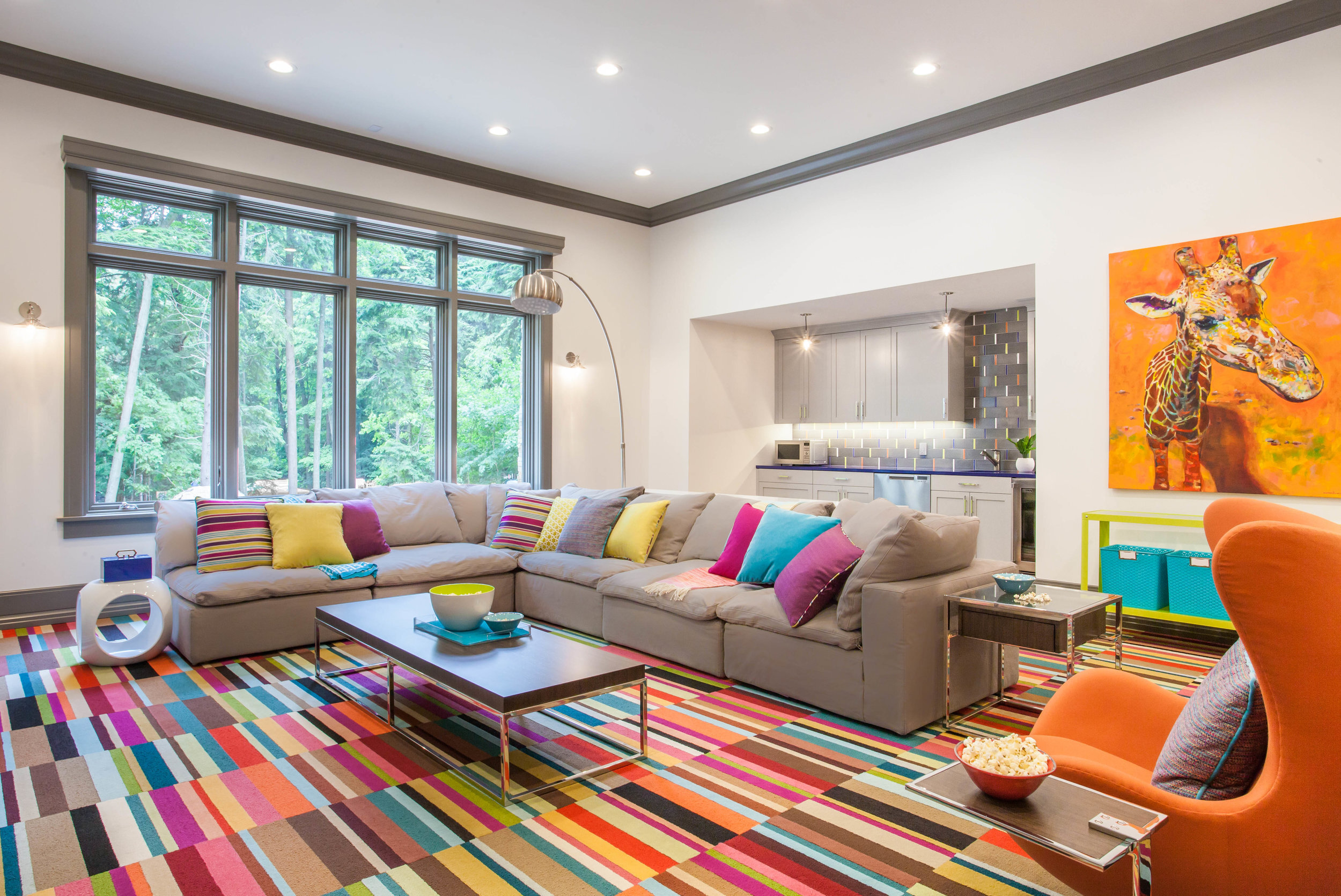
:max_bytes(150000):strip_icc()/how-to-mix-and-match-throw-pillows-like-a-pro-1791497-01-16e60d2dd6e84a489f590d1534bab67a.jpg)
Limit Key Variables
Overwhelmed by choices? Use the Rule of Three to simplify. This pro trick keeps your arrangement balanced while allowing for variety:
– Three colors (e.g., navy, cream, sage)
– Three patterns (organic, geometric, textured)
– Three sizes (e.g., 24”, 20”, 16”)
– Three textures (e.g., velvet, linen, boucle)
This isn’t a prison sentence, just a starting point. You can bend the rule (say, four colors if one is a neutral), but stick to it until you gain confidence. It prevents visual overload and keeps your design focused.
Build Around One Lead Pattern
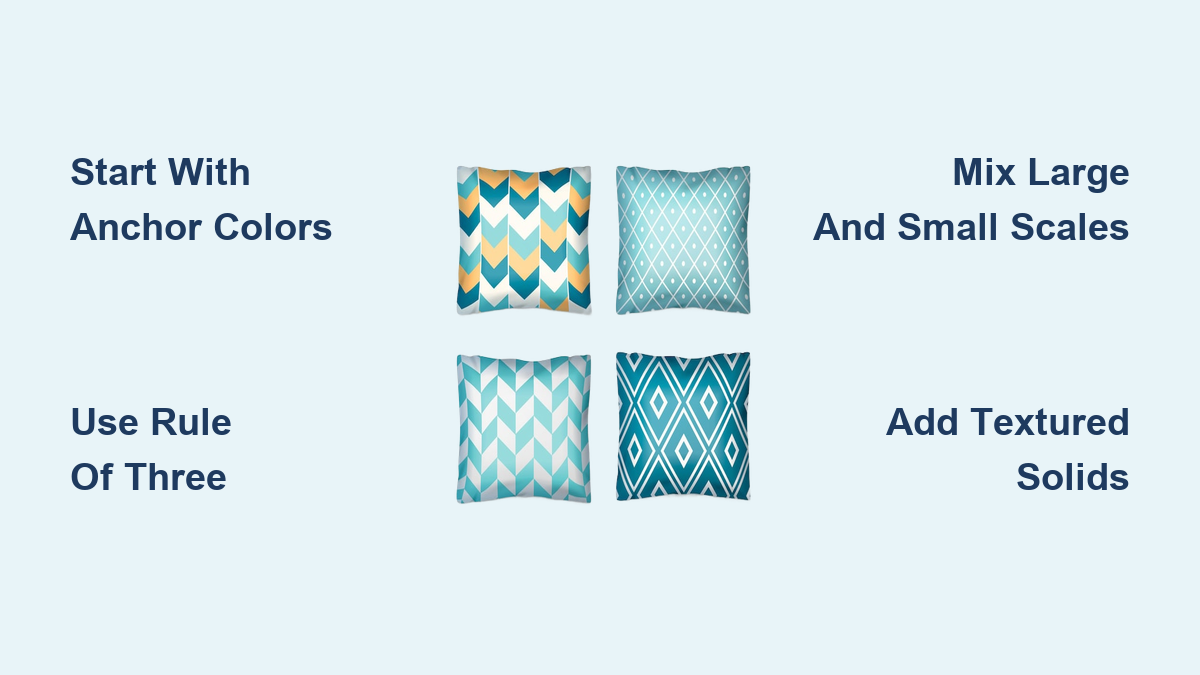
Start with a statement pillow featuring a large-scale floral, bold geometric, or artwork-inspired print. This becomes your lead pattern. It should contain all three colors of your palette. Then, choose secondary pillows that use only one or two of those colors.
For example, if your lead pillow has navy, cream, and rust, pair it with:
– A cream-and-navy stripe (geometric)
– A solid rust velvet (textured)
This creates harmony without repetition.
Choose Complementary Pattern Types
Mix Organic and Geometric
The secret to dynamic layering is contrast. Pair flowing patterns with structured ones:
– Organic patterns (florals, botanicals, abstracts) add movement and artistry.
– Geometric patterns (stripes, checks, dots) add stability and clean lines.
Never pair two bold organics like a large floral with a busy abstract. They compete. Instead, try:
– One organic + one geometric + one solid/texture
This trio gives visual interest while keeping balance.
Use Textured Solids as Anchors
Solids aren’t boring; they’re essential. A textured solid (like velvet, boucle, or waffle weave) gives the eye a place to rest. Without them, your arrangement feels chaotic.
Think of solids as the silent anchors that let patterned pillows shine. Use them in the back corners or behind statement pieces. A charcoal velvet pillow, for example, grounds a bright floral in front of it.
Vary Pattern Scale Strategically

Combine Large, Medium, and Small
Scale is everything. If all your patterns are the same size, they vibrate against each other like competing voices. Instead, vary scale dramatically:
– Large scale: Bold motifs (big florals, oversized geometrics)
– Medium scale: Standard repeats (pinstripes, small checks)
– Small scale: Tiny dots, micro-prints, tone-on-tone textures
Example: Pair a large-scale navy floral (dominant) with a medium charcoal stripe (supportive) and a small cream-on-cream dot (subtle). The eye moves smoothly from one to the next.
Avoid Uniform Repeats
Never use two large-scale patterns together. They fight for attention. If your lead pillow is large, keep supporting patterns medium or small. Save the second large print for another room or skip it entirely.
Pro tip: Hold patterns side by side. If they blur together, the scales are too similar. If one clearly dominates and the others recede, you’ve nailed it.
Balance Your Color Distribution

Spread Colors Evenly
Don’t cluster all navy pillows on one side and all cream on the other. That creates visual imbalance. Instead, distribute colors across the arrangement.
On a three-seat sofa, place a navy pillow on the left, a cream one on the right, and a rust lumbar in the center. This keeps the look stable and intentional.
Use Neutrals as Glue
Neutrals (ivory, gray, beige, black) are your unifying agents. Even in bold color schemes, include a neutral, especially in textured solids. It softens contrast and ties everything together.
For instance, in a terracotta-mustard-charcoal combo, a light gray linen pillow prevents the arrangement from feeling too heavy.
Layer With Size and Shape
Use the 2-Inch Insert Rule
A saggy pillow ruins the look. Always use an insert 2 inches larger than the cover. A 22” cover? Use a 24” insert. This creates a plump, luxurious silhouette.
Exceptions:
– Delicate fabrics (silk, thin cotton): Use exact-size inserts to avoid strain.
– Casual look: Slightly smaller inserts create a relaxed drape.
Replace inserts every few years because they lose fluff over time.
Mix Shapes for Visual Interest
Don’t just use squares. Add variety with:
– Euro pillows (26” x 26”) for beds
– Lumbar pillows (12” x 20”) for low backs
– Round pillows (16” diameter) for soft contrast
A typical sofa stack: large square (back), medium square (middle), small round or lumbar (front).
Arrange Like a Designer

Follow the Inverted Triangle (Beds)
For beds, layer in an inverted triangle:
1. Euro pillows against the headboard (base)
2. Standard sleeping pillows (hidden or fluffed)
3. Decorative squares, largest to smallest, tips pointing down
Add a lumbar at the front for comfort.
Layer Front to Back (Sofas)
On sofas:
– Back row: Largest pillows (24” or 26”) in corners
– Middle row: Medium pillows (20” or 22”)
– Front row: Small pillows or lumbar (16” or 12” x 20”)
This creates depth and invites sitting.
Choose Odd or Even Numbers Wisely
- Odd numbers (3, 5, 7): Feel collected, casual, modern
- Even numbers (2, 4, 6): Feel symmetrical, formal, traditional
For a relaxed living room, go odd. For a formal bedroom, go even. But mix sizes to avoid stiffness.
Adapt for Season and Use
Swap for Seasonal Vibes
Pillow covers are your secret weapon for seasonal refreshes.
– Fall/Winter: Swap in velvet, wool, faux fur. Use rich tones (olive, rust, cranberry).
– Spring/Summer: Switch to linen, cotton, bamboo. Use soft neutrals, pastels, or earthy tones (sage, clay).
You don’t need to replace all pillows. Just one or two can shift the mood.
Prioritize Function
Never sacrifice comfort for style. If your sofa is for lounging, leave space to sit. Avoid overcrowding. A deep sectional can handle five pillows; a shallow loveseat needs just two or three.
Use durable, washable fabrics for high-traffic areas. Save delicate silks for accent pillows that won’t get squished daily.
Avoid Common Mistakes
Don’t Buy Matching Sets
Pre-matched pillow sets look catalog-flat. They lack contrast and depth. Instead, curate your own mix. Buy covers individually, then layer them intentionally.
Don’t Ignore Texture
A room with only flat fabrics feels one-dimensional. Add texture:
– Velvet: Soft, luxe, light-reflective
– Linen: Natural, relaxed, breathable
– Boucle: Tactile, cozy, modern
– Faux fur: Warm, plush, dramatic
Even in a neutral palette, texture adds richness.
Don’t Overcrowd
Too many pillows equal unusable furniture. Edit ruthlessly. If you can’t sit down without moving three pillows, you’ve gone too far. Leave at least one-third of the sofa open.
Frequently Asked Questions About Mixing Pillow Patterns
What is the easiest way to start mixing pillow patterns?
Begin with the Rule of Three: choose three colors, three patterns (one organic, one geometric, one textured solid), and three sizes. This formula prevents overwhelm and creates instant balance, even for beginners.
How many pillows should I put on a sofa?
A standard three-seat sofa (6-8 feet) typically holds three to six pillows. Shallow loveseats need only two or three, while deep sectionals can accommodate up to seven. Always leave enough open space for comfortable seating.
Can I mix more than three patterns?
Yes, but limit yourself to three distinct patterns for cohesion. You can add textured solids beyond that count, since solids act as visual anchors rather than competing prints.
What colors work best for pillow mixing?
Pull two to four colors directly from existing room elements like rugs, curtains, or artwork. Popular professional combinations include navy, cream, and sage, or terracotta, mustard, and charcoal. Neutrals always count as anchors.
How do I choose the right pillow insert size?
Use an insert 2 inches larger than your cover for a plump, luxurious look. For delicate fabrics like silk, match the insert size exactly to avoid stretching. Replace inserts every few years to maintain fullness.
Should pillow patterns match my curtains or rug exactly?
Not exactly, but they should share at least one color or undertone with existing room elements. This creates cohesion without looking like a matched set. Pulling tones from a rug or painting is the most reliable strategy.
Key Takeaways for Mixing Pillow Patterns Successfully
Start by anchoring your color palette to existing room elements, then apply the Rule of Three to simplify your choices. Vary scale dramatically (large, medium, small) and always include a textured solid to give the eye a resting place. Remember to use inserts 2 inches larger than your covers for that polished, professional look.
Your next step: pull out your room’s most colorful element (a painting, rug, or curtain), identify three tones within it, and shop for one organic pattern, one geometric pattern, and one textured solid in those exact shades. Test the combination on your sofa before committing. You’ll be surprised how quickly the chaos turns into curated style.