How to Choose a Travel Pillow
We’ve all been there: waking up on a long flight with a stiff neck, drool on our shirt, and a head that just wouldn’t stay upright. A good travel pillow isn’t a luxury; it’s a necessity for staying rested and avoiding pain. But with so many shapes, sizes, and styles, knowing how to choose travel pillow options wisely can feel overwhelming. The right one keeps your neck aligned, supports your head in any position, and fits in your carry-on.
The key is matching your sleeping style, travel environment, and personal comfort needs to the right design. Whether you’re a forward nodder, side leaner, or restless sleeper, there’s a pillow engineered for your biomechanics. This guide cuts through the noise using real performance data, expert testing, and user feedback to help you pick the perfect travel pillow without guesswork.
Match Your Sleep Style First
Your sleeping position during travel is the number one factor in choosing the right pillow. Most people fall into one of four categories, and each requires a different support strategy.
Forward Nodders: Chin Hits Chest
If your head drops forward and your chin ends up on your chest, you’re a forward nodder. This strains neck muscles and cuts off airflow. You need a pillow that lifts and cradles your jaw.
Best Pillow: Bcozzy
The Bcozzy is the top-rated pick for forward nodders. Its unique overlapping coil design lets you position the seam under your chin, creating a soft shelf that prevents drooping. Unlike traditional U-shaped pillows, it doesn’t push your head forward; it supports it where you need it most.
- Why it works: Adjustable overlap equals customizable chin support
- Bonus: Lies low on shoulders with no interference from over-ear headphones
- Who it fits: Short and long necks through adjustable height
Alternative: J-Pillow
The J-Pillow has a dedicated chin cradle built into its “J” shape. It’s effective but only works in window seats, where you can lean the side against the wall. In middle or aisle seats, it lacks lateral support and can slip off.
Side Leaners: Head Tilts to One Side
Side sleepers often end up on a stranger’s shoulder or the cabin wall. You need firm lateral support to keep your head upright.
Best Pillow: Trtl Travel Pillow
The Trtl uses a hidden plastic brace inside a soft fleece wrap, functioning like a wearable neck brace. It locks your head in place, stopping the “bobblehead” effect better than any foam pillow.
- Why it works: Internal brace provides medical-grade side support
- Best for: Long-haul flights, train rides, or anyone who leans consistently to one side
- Drawback: Can feel tight or warm; not ideal for restless sleepers
Alternative: Cabeau Evolution X
With solid plastic braces on both sides, the Cabeau Evolution X offers even stronger support. It’s ideal if you need maximum rigidity, such as after neck strain or injury. But the hard braces can press into your cheeks, making it less comfortable for some.
Restless Sleepers: Shift Between Positions
If you toss and turn between side, forward, and back positions, you need 360-degree support that adapts to movement.
Best Pillow: Ostrichpillow Go Neck
The Ostrichpillow Go combines soft modal fabric with memory foam and an asymmetrical design. Flip it to support your preferred side, or wear it centered for all-around cushioning. The Velcro closure lets you adjust tightness for a custom fit.
- Why it works: Soft, sweater-like feel plus adjustable height
- Ideal for: Travelers who can’t stay still or want plush comfort
Alternative: Bcozzy
Yes, the Bcozzy works here too. Its continuous loop ensures no gaps form as you shift, making it one of the few pillows that handle multiple positions well.
Backward Sleepers: Head Rests Against Seat
Some travelers prefer leaning straight back. The problem? Most U-shaped pillows push your head forward, misaligning your spine.
Best Pillow: Travelrest Nest Ultimate
This pillow has a flattened back profile, so your head rests flush against the seat. High memory foam walls prevent side-to-side drift, and a Velcro chin strap stops forward drooping.
- Why it works: Flat back equals proper headrest contact
- Bonus: Rubber grip dots keep it from sliding down the seat
Alternative: Cabeau Evolution S3
Also features a thinner back and high side walls. It’s especially good for tall travelers (up to 6’4″) thanks to its extended height.
Compare Support Types and Materials
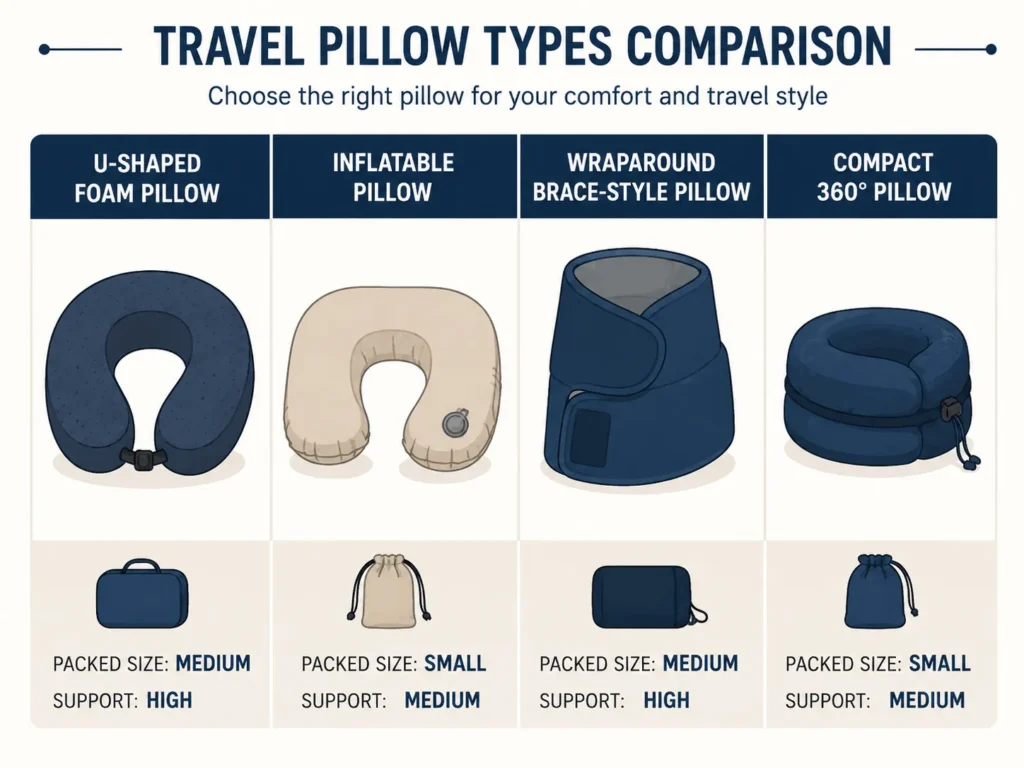
Not all travel pillows are built the same. The fill and structure determine comfort, durability, and temperature.
Memory Foam: Maximum Support, Some Heat
Memory foam molds to your neck and holds its shape, offering excellent stability.
- Pros: Superior support, pressure relief, long-lasting
- Cons: Retains heat, heavier, bulkier
- Best for: Comfort seekers who don’t mind weight
- Top picks: Travelrest Nest, Cabeau S3, Ostrichpillow Go
Polyester Fiberfill: Soft, Washable, Breathable
Used in the Bcozzy and J-Pillow, this fill is soft like a bed pillow and breathes well.
- Pros: Cool, lightweight, fully machine washable
- Cons: Less structural support, may flatten over time
- Best for: Hot sleepers, frequent washers, headphone users
Internal Bracing: Rigid Support for Side Sleepers
The Trtl and Cabeau Evolution X use plastic braces inside soft fabric.
- Pros: Prevents head bobbing, mimics medical collars
- Cons: Can feel restrictive, less plush
- Best for: Side sleepers, those with neck issues
Inflatable: Pack Small, Sacrifice Comfort
Inflatables like the Cabeau Air TNE deflate to soda-can size, perfect for ultralight packers.
- Pros: Extremely compact, adjustable firmness
- Cons: Less comfortable, risk of leaks, can feel plasticky
- Best for: Backpackers, tight carry-ons
- Tip: Choose models with plush covers (like Cabeau Air TNE) for better feel
Microbeads: Soft but Flawed
Found in budget pillows like Cloudz, microbeads mold instantly but have downsides.
- Pros: Conforms quickly, soft texture
- Cons: Heavy, noisy, can leak, retains heat
- Verdict: Avoid unless on a tight budget
Prioritize Portability and Packing
A pillow that’s too bulky defeats the purpose. Balance comfort with how small it packs.
Most Compact Options
- Trtl Travel Pillow: Rolls to book size (~5″ x 7″)
- Cabeau Air TNE: Deflates to soda can size (~2.5″ x 5″)
- Travelrest Nest: Compresses to 25% of size with included case
Bulkiest (But Worth It for Comfort)
- Travelrest Nest (uncompressed): Full-size memory foam
- J-Pillow: Irregular shape, hard to pack neatly
- Ostrichpillow Go: Large and soft, doesn’t compress well
Pro Tip: Look for pillows with snap loops or carrying cases. The Bcozzy includes a snap to attach to luggage, so no extra bag is needed.
Choose Fabrics That Breathe
Your pillow’s cover affects temperature and skin comfort.
Cool-Feeling Fabrics
- Modal (Ostrichpillow Go): Silky, breathable, derived from beech trees
- Rayon (Trtl Cool): Moisture-wicking, cooler than fleece
- Ventilated Polyester (Cabeau Cool): Designed to reduce heat buildup
Warm or Heat-Retentive
- Fleece (Trtl, J-Pillow): Great for cold cabins but can overheat
- Velour (Travelrest Nest): Plush but traps heat
Hot sleepers: Avoid fleece and thick memory foam. Go for Bcozzy (fiberfill) or Cabeau Cool (vented fabric).
Cold sleepers: Embrace fleece or plush memory foam. They add warmth.
Fit Your Neck and Head Size
A one-size-fits-all pillow rarely fits all. Match height and circumference.
For Tall Adults or Long Necks
- Cabeau Evolution S3: Tallest side walls on the market
- Cabeau Evolution X: Also high, with dual braces
- Tested on users up to 6’4″
For Short Necks or Kids
- Bcozzy: Adjustable overlap allows shorter necks to reduce height
- Cirorld: Smaller memory foam pillow (~$17)
- Bcozzy Kids: Available in smaller size
Warning: High-walled pillows (like Cabeau) can press on ears when wearing headphones. Try before you fly.
Evaluate Hygiene and Durability
A pillow should last years and stay clean.
Machine Washable (Whole Pillow)
- Bcozzy, J-Pillow, Cloudz: Toss the entire thing in the washer
- Best for: Frequent travelers, hygiene-focused users
Washable Cover Only
- Travelrest Nest, Cabeau, Ostrichpillow Go: Remove cover, hand or machine wash
- Foam core: Spot clean only
Hand Wash or Wipe Clean
- Trtl: Fleece wrap washable, but avoid soaking plastic brace
- Inflatables: Wipe with damp cloth
Durability Tips:
– Store memory foam uncompressed when possible
– Deflate inflatables partially before storage
– Wash covers regularly to prevent oil buildup
Pick Based on Travel Type
Your mode of transport changes what you need.
Airplane Travel
- Best: Travelrest Nest, Bcozzy, Trtl
- Why: Compact, prevents head drop, works in upright seats
- Window seat? J-Pillow excels here
Car or Bus
- Best: Cabeau S3 (with seat strap), Bcozzy
- Why: Seat strap prevents slipping; Bcozzy adapts to reclined positions
Train
- Best: Trtl
- Why: Rigidity counters train sway and vibrations
Make the Final Choice: Best Pick by Traveler Type

Still unsure? Match your profile to the top pick.
The Average Traveler
→ Travelrest Nest Ultimate
Best overall balance of comfort, support, and packability. High ratings across all categories.
The Forward Nodder
→ Bcozzy
Unmatched chin support. Adjustable, headphone-friendly, washable.
The Side Sleeper
→ Trtl Travel Pillow
Rigid brace stops head tilt. Ultra-compact. Ideal for consistent leaners.
The Tall Traveler
→ Cabeau Evolution S3
High walls fit long necks. Thin back keeps head aligned with spine.
The Ultralight Packer
→ Cabeau Air TNE
Deflates to soda can size. Plush cover beats cheaper inflatables.
The Luxury Seeker
→ Ostrichpillow Go Neck
Premium modal fabric, asymmetrical support, luxurious feel.
The Window Seat Sleeper
→ J-Pillow
Unique “J” shape uses the wall for support. Ineffective elsewhere.
The Budget Buyer
→ Cirorld (~$17) or Cloudz (~$18)
Basic support at low cost. Good for occasional travel.
Frequently Asked Questions About Travel Pillows
What type of travel pillow is best for airplanes?
The best airplane travel pillows prevent forward head drop and fit in economy seats. The Travelrest Nest Ultimate and Bcozzy top most rankings for upright sitting. For window seats, the J-Pillow offers unmatched lean support.
How do I choose a travel pillow for neck pain?
Choose a pillow with rigid support or high walls to maintain spinal alignment. The Trtl (internal brace) and Cabeau Evolution X (dual braces) provide medical-grade stability. Chiropractors recommend C-shaped designs with thin backs and thick sides to keep your head flush against the headrest.
Are memory foam travel pillows worth it?
Memory foam pillows offer superior support and pressure relief but retain heat and weigh more. They’re worth it if you prioritize comfort over packability. If you’re a hot sleeper or need something lightweight, consider polyester fiberfill (Bcozzy) or inflatable options (Cabeau Air TNE) instead.
Can travel pillows be machine washed?
Some can. The Bcozzy, J-Pillow, and Cloudz are fully machine washable. Memory foam models like Travelrest Nest and Cabeau have removable, washable covers but require spot cleaning for the foam core. Inflatables should only be wiped with a damp cloth.
What is the most compact travel pillow?
The Cabeau Air TNE is the most compact, deflating to roughly soda-can size (~2.5″ x 5″). The Trtl is a close second, rolling to book size (~5″ x 7″). Both are ideal for ultralight packers and tight carry-ons.
Do travel pillows work with headphones?
Some do, some don’t. Low-profile pillows like the Bcozzy lie flat on the shoulders and won’t interfere with over-ear headphones. High-walled memory foam pillows (Cabeau S3, Travelrest Nest) can press against your ears. If headphones are essential, prioritize adjustable or low-rise designs.
Final Thoughts on Choosing Your Perfect Travel Pillow
The best travel pillow isn’t one-size-fits-all. It’s the one that matches how you sleep, where you go, and what you value, whether that’s support, packability, or washability.
Start by identifying your dominant sleep position, since this single factor determines which design category will work for you. Then narrow your options based on material preferences, fabric breathability, and how much space you have in your bag. Finally, consider hygiene and durability to ensure your investment lasts for years of journeys.
Use this guide to cut through marketing hype and choose with confidence. With the right pillow, your next trip can end with rest, not regret.